

Mobilex DF folding wheelchair ramp



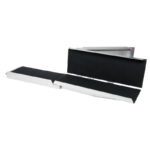


Mobilex DF folding wheelchair ramp – 180, 240 and 300 cm
The Mobilex DF folding wheelchair ramp is a portable aluminium ramp for higher level differences – several entrance steps, a landing in front of a door, a high threshold or the steps at a building entrance. It is designed for wheelchair and mobility scooter users and their carers. Depending on the length, it bridges a total rise of up to 36 cm (DF‑180), 48 cm (DF‑240) or 60 cm (DF‑300).
What sets the DF apart is its two‑piece design – separate left and right halves. Each half folds in the middle and is carried by its handle like a suitcase; before use, the halves are joined with a snap‑in connection lock. This means even a 3‑metre ramp can be carried as two lighter parts and stored in a small space. The ramp needs no installation and no alterations to the entrance – you set it up only when you need it.
DF ramp sizes – length and maximum rise
| Model | Length | Max. rise* | Weight (both halves) | Folded size – 1 half (L × W × H) |
|---|---|---|---|---|
| DF‑180 | 180 cm (approx. 5 ft 11 in) | 36 cm (approx. 14 in) | 16 kg (approx. 35 lb) | 91 × 36 × 19 cm |
| DF‑240 | 240 cm (approx. 7 ft 10 in) | 48 cm (approx. 19 in) | 22 kg (approx. 49 lb) | 124 × 40 × 19 cm |
| DF‑300 | 300 cm (approx. 9 ft 10 in) | 60 cm (approx. 24 in) | 27.2 kg (approx. 60 lb) | 154 × 40 × 19 cm |
* at the maximum permitted incline of 12°, as stated in the instructions for use.
Key benefits of the DF ramp
- For high obstacles – up to 60 cm – the DF‑300 bridges a rise equivalent to several entrance steps.
- Two suitcases instead of one heavy ramp – the weight is split between two separate halves, so the ramp is easier to carry, load into a car boot and store.
- Secure connection of the halves – the connection lock engages automatically when the second half is slid in and is released with a single button.
- Wide 75 cm driving surface – with an overall width of 79 cm; 6 cm side edges help keep the wheels on the ramp.
- Anti‑slip surface – the driving surface is coated with an anti‑slip aluminium silicate material for stable travel.
- 300 kg maximum load – the limit covers the user, the wheelchair or scooter and the carer, who walks on the ramp surface.
- Robust construction – aluminium design that meets the needs of institutions and public buildings.
- No installation – ready to use once unfolded and connected; it is not fixed permanently to the ground.
What is included?
- 2 ramps – left and right half, each folding into a suitcase with a carrying handle,
- 1 user manual.
The manufacturer provides no additional accessories for the DF ramp. After unpacking, check the contents against the list above – if a part is missing or damaged, contact your supplier.
DF ramp design
DF ramps are foldable aluminium platforms. To make handling and transport easier, the ramp is divided into two foldable halves that are connected for use. Each half consists of:
- label “A” – marks the end placed on the elevated surface,
- carrying handle,
- distance spacer,
- label “B” – marks the end placed at ground level,
- connection lock with unlocking button – joins both halves into one ramp,
- anti‑slip surface made of aluminium silicate,
- side protection – a 6 cm high edge.
Who is the DF ramp for?
Ramps are indicated for people with mobility limitations who, due to problems with walking, standing or sitting, use mobility devices such as wheelchairs, scooters and rollators. The DF ramp is particularly suitable for:
- Wheelchair users who regularly need to get up several steps at home or at a building entrance, where a permanent ramp is not possible or not cost‑effective.
- Mobility scooter users who need a long ramp to reach a landing or entrance steps.
- Carers and family members – splitting the ramp into two suitcases makes it easier to carry, set up and put away after each use.
- Care homes, healthcare facilities, public offices and businesses that need a portable way to improve entrance accessibility without building work.
The product can be used in home care, healthcare and long‑term care facilities, and hospitals. The ramp is intended for independent use or use with the help of an attendant.
How to choose the right DF ramp length
- Measure the rise. Measure vertically from the ground to the highest point. For steps, add up the height of all steps.
- Check the space in front of the obstacle. The ramp needs space for its full length, and the wheelchair needs an extra 1.5 m or so to manoeuvre at the bottom of the ramp.
- Choose the length. Up to 36 cm – DF‑180, up to 48 cm – DF‑240, up to 60 cm – DF‑300. The length is chosen so that the ramp incline does not exceed 12°. The longer the ramp relative to the rise, the gentler the slope – if you have the space, a longer model will be more comfortable, especially for independent use.
Important: the choice of a suitable ramp type and length must always be made with the help of a specialist doctor or physiotherapist. The maximum rise for each model is stated in the instructions for use and must not be exceeded.
Which steps and entrances is the DF ramp suitable for?
The DF is a straight ramp that must lie in one continuous run from the ground to the top of the obstacle. It is suitable when all of the following apply:
- the total rise does not exceed the maximum for the chosen model (36, 48 or 60 cm),
- the steps or raised area form one straight section,
- there is a stable, flat surface at the top for end “A” – for example a landing in front of the door,
- there is enough space in front of the obstacle for the full ramp length and for manoeuvring the wheelchair.
The DF ramp is not a solution for steps higher than 60 cm, stairs with a landing or a turn halfway up, or a communal stairwell with several flights. In such places the ramp has nowhere to rest, or the incline would exceed the permitted 12°.
DF ramp or stair climber – which one do you need?
The DF ramp is a good choice when:
- the obstacle is up to 60 cm high and forms one straight section,
- there is room in front of the obstacle to lay out the ramp and manoeuvre the wheelchair,
- the user is to ride up in their own wheelchair or scooter, without transferring,
- the carer can safely push the wheelchair up the ramp, or the user can ride up independently.
Consider a stair climber when:
- the obstacle is higher than 60 cm – e.g. a stairwell in a block of flats or tall entrance stairs,
- the stairs have a landing or change direction,
- there is no room for a long ramp in front of the stairs,
- the carer has limited strength and pushing the wheelchair up a ramp would be too demanding.
Stair climbers allow a person with reduced mobility to be transported up and down stairs. Mobilex offers tracked, stepping and seat‑type stair climbers. If you are not sure which solution is right, book a consultation to choose the right device.
DF, SR or SF ramp – what is the difference?
- DF – two separate halves connected before use, length 180–300 cm, rise up to 60 cm, 75 cm driving surface. Best when you need the greatest height or a lighter single part to carry.
- SR – a single multi‑fold ramp (folds in width and in length), length 180 or 240 cm, rise up to 48 cm, 72 cm driving surface. Best when you do not want to connect halves and prefer one shorter package.
- SF – a single suitcase ramp, length 90–150 cm, rise up to 30 cm, 73 cm driving surface. Best for thresholds, kerbs and one or two steps.
How to unfold and position the DF ramp
- Unfold the first half – unlock the buckle lock and unfold it. Repeat for the second half.
- Connect the halves – press and hold the button on the connection lock of the right half, then slide the locking element of the other half into it until the lock engages automatically and the button pops out.
- Position the ramp – place the side labelled “A” on the elevated surface and the side labelled “B” at ground level.
- Check stability – before use, make sure the ramp is steady and placed on a stable surface.
To separate the halves, press the lock button and pull the ramps apart. If the ramp does not open, check that the buckle locks are unlocked.
Safe use
- Do not exceed the maximum rise – DF‑180: 36 cm, DF‑240: 48 cm, DF‑300: 60 cm.
- Do not exceed the 300 kg maximum load stated in the technical data and on the product label.
- Use the ramp only on a stable surface – if the ramp is not stable, place it on a flat, smooth surface and check that it has not been laid upside down.
- Mind your fingers – when folding and unfolding, there is a risk of fingers being trapped or cut between parts of the ramp.
- Use the ramp only in flawless condition – if you find any defect, contact your dealer immediately.
- Do not modify the ramp – structural changes without the manufacturer’s written consent void the CE marking and the warranty.
- Make sure everyone using the ramp has read the manual – including carers and facility staff.
Cleaning, storage and transport
Cleaning: normal dirt can be removed with standard cleaning products and a sponge or soft cloth. Use only products suitable for cleaning and disinfection – no alcohol‑based products, solvents or abrasives.
Inspection: the ramp basically requires no maintenance, but like any product it is subject to wear. The manufacturer recommends regular checks by a professional service – cleaning and disinfection, checking that the structure is not bent, damaged, worn or corroded, and checking and, if necessary, replacing wear parts.
Storage: in a dry place at a temperature above 0°C, away from intense sunlight.
Transport: the halves are separated, folded and secured with the buckle lock. Transport them in a stable, secured way with no risk of sudden movement.
Service life and reuse: the expected service life is normally up to 10 years, depending on use. The ramp is suitable for reuse – before it is passed to a new user, it must be checked according to the manufacturer’s recommendations.
Frequently asked questions
Which DF ramp do I need for the steps in front of my house?
Add up the height of all the steps. Up to 36 cm, the DF‑180 is enough; up to 48 cm – DF‑240; up to 60 cm – DF‑300. Also check that there is room in front of the steps for the full ramp length plus about 1.5 m to manoeuvre the wheelchair. If the rise is within the range of a shorter model but you have enough space, a longer ramp will give a gentler slope.
Is a 12° incline the same as a 1:12 ramp?
No. A 1:12 gradient (about 4.8°) is the slope commonly required for permanent ramps in building regulations. The 12° stated for the DF ramp is the maximum incline permitted by the manufacturer for this portable ramp – about 20 cm of rise per metre of ramp length. At the maximum rise the ramp is therefore steep and many users will need the help of a carer. If you have room, choose a longer model to reduce the incline.
How is the DF ramp different from the SR ramp, as both come in 180 and 240 cm?
The DF consists of two separate halves connected with a lock before use – it has a wider driving surface (75 cm) and splits into two suitcases, so each part you carry is lighter than the full set. The SR is a single multi‑fold ramp – it has a 72 cm driving surface and is carried as one piece. Choose the DF if the weight of each part you lift matters more or if you need the 300 cm version; choose the SR if you prefer not to connect halves.
Which wheelchairs is the DF ramp suitable for?
The ramp is designed for wheelchairs and mobility scooters. Before buying, check two things: that the combined weight of the user, the wheelchair or scooter and any carer does not exceed 300 kg, and that the wheel track fits within the driving surface width (75 cm between the side edges). For heavy power wheelchairs and scooters, check the vehicle weight in its technical data.
Can the DF ramp be used in a communal stairwell?
Only if it is a single straight flight with a total rise of up to 60 cm, with space in front of the steps and a stable surface at the top. In a stairwell with several flights, a landing or a turn, the ramp will not work – a stair climber is the better solution.
Can a wheelchair user ride up the DF ramp independently?
The ramp is intended for independent use or use with the help of an attendant. At the maximum rise the incline reaches 12°, which is a considerable effort for many self‑propelling wheelchair users. Decide together with a doctor or physiotherapist whether independent use is safe; if you have room, consider a longer model.
How much does the DF ramp weigh and can one person carry it?
The set of two halves weighs 16 kg (DF‑180), 22 kg (DF‑240) or 27.2 kg (DF‑300). Because the ramp splits into two separate suitcases with handles, they are carried one at a time – each part weighs roughly half of the full set.
Warranty and service
Mobilex A/S offers a 2‑year warranty covering defects caused by production or material errors. The warranty does not cover unauthorised repair, use not in line with the intended purpose and the instructions, parts subject to normal wear (unless the wear is caused by a manufacturing fault) or transport costs. Advice on choosing a ramp and service in Poland are provided by Mobilex Sp. z o.o., ul. Duńska 3/5, 91‑204 Łódź.

| Parameter | DF‑180 | DF‑240 | DF‑300 |
|---|---|---|---|
| Length | 180 cm | 240 cm | 300 cm |
| Overall width | 79 cm | ||
| Driving surface width | 75 cm | ||
| Side protection height | 6 cm | ||
| Max. incline / max. rise | 12° / 36 cm | 12° / 48 cm | 12° / 60 cm |
| Weight (both halves) | 16 kg | 22 kg | 27.2 kg |
| Max. load | 300 kg (approx. 661 lb) | ||
| Folded size – 1 half (L × W × H) | 91 × 36 × 19 cm | 124 × 40 × 19 cm | 154 × 40 × 19 cm |
| Material | aluminium | ||
| Surface | anti‑slip, aluminium silicate | ||
| Folding and transport | separates into two halves, each folding lengthwise into a suitcase with a carrying handle | ||
| Carer | walks on the ramp | ||
| Installation | not required | ||
| Accessories | none provided | ||
| Package contents | 2 ramps (left and right half), 1 user manual | ||
| Expected service life | normally up to 10 years, depending on use | ||
| Classification | Class I medical device, CE, Regulation (EU) 2017/745 | ||
| REF | DF-180 | DF-240 | DF-300 |
| UDI‑DI | 5740001415278 | 5740001415285 | 5740001415292 |
| Warranty | 2 years | ||
| Manufacturer | Mobilex A/S, Grønlandsvej 5, 8660 Skanderborg, Denmark | ||
| Distributor in Poland | Mobilex Sp. z o.o., ul. Duńska 3/5, 91‑204 Łódź, Poland | ||
