




Toilet and Bathroom Aids – shower chairs, commodes, raised toilet seats and grab bars
Welcome to our Toilet and bathroom category – a practical selection of bathroom safety aids designed to support safer hygiene routines, easier transfers, and greater independence for seniors and people with reduced mobility. Here you’ll find solutions for the shower, bathtub and toilet area that help reduce strain for both users and caregivers.
Browse the products below and use the guide to choose the right equipment for your space, the user’s needs, and the level of support required.
What will you find in the Toilet and bathroom category?
This category includes key product groups for daily hygiene and bathroom mobility:
- Shower stools – compact seating support for showering, available in different shapes and functions: Round shower stool, Triangular shower stool (space-saving shape), Shower stool with swivel seat (easier turning), Shower stool with backrest, Shower stool.
- Bath and shower boards – support for safer bathing over the bathtub edge, e.g. Shower board (bath bench with handle).
- Commode and shower chairs – multi-purpose solutions for toileting and washing, including a versatile TOILET & SHOWER CHAIR 3in1 with toilet bucket that can be used as a commode chair, shower seat, and toilet support frame.
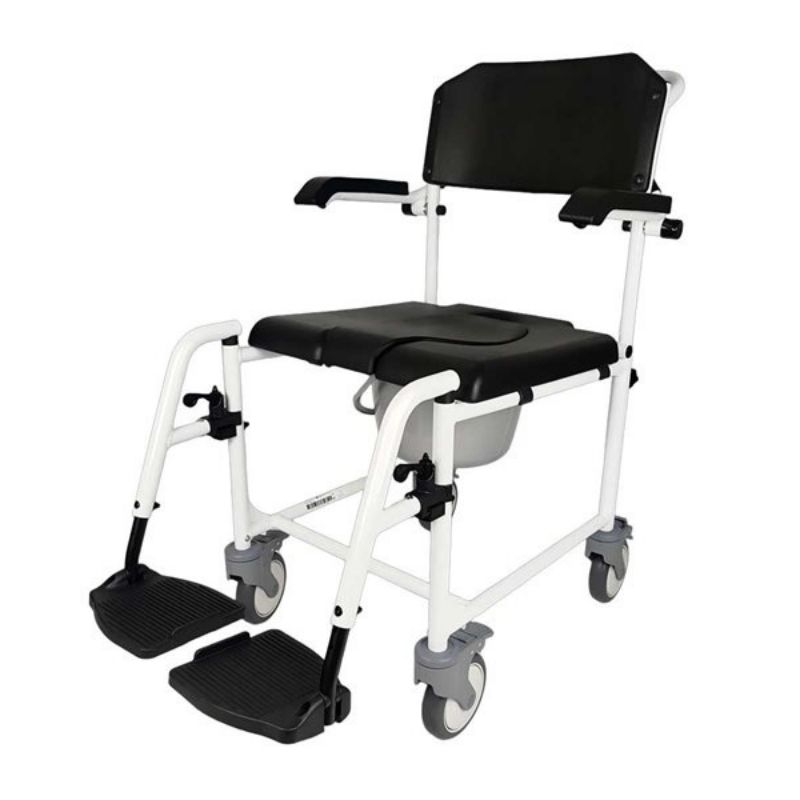
- Shower & commode wheelchairs – for users who need assisted transfers and stable positioning during hygiene: Shower chair & commode with tilt & headrest, version with small rear wheels, version with large rear wheels.
- Raised toilet seats – for easier sit-to-stand and reduced joint strain: Raised toilet seat (with lid), Raised toilet seat (without lid), Raised toilet seat with armrests.
- Grab bars and support rails – for safer transfers next to the toilet, shower, or bathtub: Grab bars and Wall mounted folding support rail.
If you’re building a complete mobility setup, see also: Wheelchairs, Rollators, Ramps, Daily Living & Rehab Aids, Patient Transfer Aids.
How to choose the right toilet and bathroom aid?
1) Identify the main scenario: shower, bathtub, toilet – or all of them
- Showering independently – a shower stool can be enough when balance is reasonably good and the user can transfer safely.
- Limited space – choose compact options like a triangular stool that fits neatly into a shower corner.
- Bathing in a bathtub – a bath board helps reduce the risky “step-in” and supports seated transfers over the tub edge.
- Toilet support and easier sit-to-stand – consider a raised toilet seat; for more assistance, choose a raised seat with armrests.
- Toileting + showering in one product – a multifunctional commode solution such as a 3-in-1 toilet & shower chair can simplify daily care.
2) Choose the right level of support and positioning
- Stool vs chair: if the user needs trunk support or gets tired quickly, a model with backrest improves comfort and stability.
- Swivel seat: helpful when turning in place is difficult or painful (hips, knees, post-op recovery).
- Wheelchair-format commode/shower chair: best when transfers require assistance and the user needs stable seating plus caregiver-friendly handling.
3) Focus on safety: stable transfers and reliable support points
- Grab bars and folding rails provide a predictable handhold where slips are most common (near toilet, shower entrance, bathtub).
- Armrests (on selected toilet seats or hygiene chairs) can make standing up and sitting down more controlled and less painful.
- Brakes on wheeled commode chairs help keep the device stable during transfers and hygiene routines.
4) Check fit and adjustability
- Measure the bathroom: doorway width, turning space, and distance to walls around the toilet/shower.
- Seat height matters: correct height makes sit-to-stand easier and reduces strain on knees and hips.
- Compatibility: for raised toilet seats, confirm the model fits standard toilet bowls and the mounting style matches your needs.
5) Cleaning and durability for daily use
Bathroom equipment should be easy to wipe down and suited to wet environments. Many solutions in this category use materials designed for frequent cleaning and moisture exposure (important for home care and medical facilities).
Common mistakes to avoid
- Choosing a stool when the user actually needs back support or assisted transfers.
- Skipping wall support (grab bar/rail) in key transfer zones such as next to the toilet or at the shower entry.
- Not measuring tub width or available space before selecting a bath board or wheeled shower chair.
- Ignoring maximum user weight and stability requirements for long-term daily use.
Why buy Toilet and bathroom solutions at Mobilex?
- Purpose-built selection – from compact shower stools to advanced commode/shower wheelchairs with positioning support.
- Practical product information – clear descriptions and technical data help you match equipment to the user and the bathroom layout.
- Documentation available on product pages – many items include downloadable files such as user manuals and declarations of conformity.
- Easy internal navigation – complement bathroom safety with mobility and care equipment from: Rollators and Patient Transfer Aids.
FAQ – Toilet and bathroom aids
What’s the difference between a shower stool and a shower chair?
A shower stool is usually more compact and works well when the user has adequate balance and needs basic seated support. A shower chair (often with backrest and arm support) is better when additional stability, comfort, or caregiver assistance is needed.
When should I choose a raised toilet seat?
A raised toilet seat is helpful when sitting down or standing up is difficult due to reduced leg strength, joint pain, or post-surgery recovery. Versions with armrests can provide extra support and improve transfer safety.
Where should grab bars be installed?
Grab bars are most useful wherever transfers happen: next to the toilet, near the shower entry, and along the bathtub area. Choose a configuration that supports the user’s natural hand placement during sitting, standing, and turning.
Can a commode chair also be used for showering?
Yes—selected models are designed as shower & commode chairs, combining hygiene support with moisture-resistant construction and caregiver-friendly features. If the user needs assisted positioning, consider a version with brakes and supportive seating.
This is a medical device. Use it in accordance with the instructions for use and safety guidelines provided with the product.
Make daily hygiene safer and more comfortable
Explore our Toilet and bathroom range and choose equipment that improves stability, reduces effort, and supports independence—at home, in care facilities, or during rehabilitation. For quick selection, start with: 3-in-1 toilet & shower chair, raised toilet seats, or grab bars.